‘Get Out’ (2017) is a modern horror film, directed by Jordan Peele, that earned him nominations for best director and best picture at the Oscars. The film, on the surface, is a horror/thriller with a modern spin. However, the overarching message of the film explores that of Neo-slavery and an underlying racism in liberal America. In this essay, I will explore how social and cultural contexts in the production are crucial in shaping the formal choices of the film. To do this, I will delve into certain scenes, and aspects of the film, looking more specifically into the mise-en-scène within the film, exploring mainly colour and symbolism. The film itself struggles to classify as an exact genre, as it lacks the pace and action of a thriller, but also the jump scares and physical terror of a typical horror film. The failure to give the film an exact classification plays into its feeling of a surreal daydream. It is not quite believable, but just enough so to make us question our society. The picture explores slavery as a modern practice, much like how the horror element to the film has been modernised, making us doubt our equal society and showing that ‘history shapes the nature of our fantasies and dreams’ (Holmes 2018, p.306).
The formal choices within the film look to challenge traditional values in modern films containing multiple ethnicities. Movies such as ‘BlacKkKlansman’ (2018) and ‘Mississippi Burning’ (1988) look to unify both Black and White characters, by expressing their shared values or morals and beliefs. ‘Get Out’, however continually contrasts Chris, played by Daniel kaluuya, with Rose Armitage, played by Allison Williams, and other members of the Armitage family through the use of colour. Chris is a black man, living in America, with his girlfriend, Rose, ‘whose skin is lit and shot in a way that underscores her whiteness’ (Adams 2018, p.171). Already before the two have interacted, there is already an emphasised difference in the physical appearance of them. At this introduction to the characters, there is the beginnings of ‘an obvious racial undercurrent that drives the film’ (Jeffries 2018, p.148). Other ways in which colour is shown to contrast Black and White people is through items of clothing. Chris and Rose venture down to her parents house in rural America. A party takes place at the house, where Chris is in the minority, surrounded by dozens of White middle-aged men and women. Everyone present at the party wears at least one red piece of clothing, except Chris. Red represents ‘danger’ (Bourn 2011), and is an immediate sign not to trust the those characters. Rose wears a striped white and red jumper, showing a mix of ‘purity’ and ‘danger’ (Bourn 2011), representing the audience’s mixed emotions towards her, torn between whether to trust her or not. In contrast, Chris wears a blue jacket to the party, a direct opposite to red, and also a sign of ‘freedom’ and ‘trust’ (Bourn 2011). At this point in the film, the exact agenda of the characters is still unknown, but the colours help to establish the trustworthy amongst them. Another way in which colour within the film helps to create a contrast between the characters comes at the end of the same scene previously explored. When Chris and Rose come together at the party, Chris’s blue , and Rose’s red and white stripes represent the American flag, a symbol of freedom. However, others may view the flag as a symbol of the past, a symbol of slavery. Although seemingly unifying the characters at this point, there contradicting views of the flag become clear, with Chris believing in freedom and loyalty, juxtaposed to Rose, and her family’s belief in modern day slavery. ‘the pose of the post-racial masks liberal whites’ active complicity in the oppression of African Americans’ (Landsberg 2018, p.635).

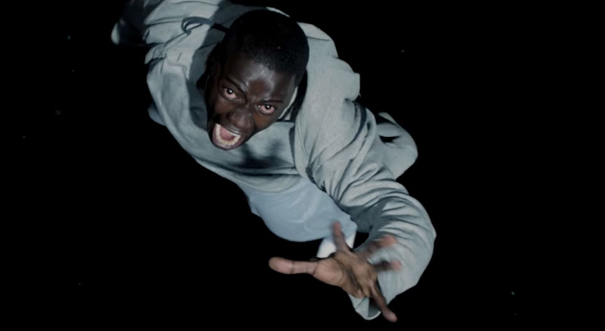
As the agendas of characters are slowly unveiled, it becomes clear that the elderly White people have their consciousness put into the mind of a Black man, namely Chris, through hypnosis. Rose’s mother hypnotises Chris, leaving him in a state of paralysis, able to see everything, but control nothing. While in this state, he is floating in a black vacuum, wrapped in white clothing. The colours and clothing here are foreshadowing what is to come. through contrast. While Chris wears all white clothing, only showing his face, the White man that is to inherit his body will essentially wear Chris’s Black skin, showing a complete contrast between the two characters, and their seemingly inevitable fates. Through psychological aspects, such as hypnosis, ‘the film literalizes an exaggerated version of white exploitation of blacks’ (Landsberg 2018, p.633), much like in the past. The use of colour in film develops already existing techniques involving colour in film. Movies have always used colour as a way to tell a story, however Peele develops this practice, showing the versatility of colour in film.
This leads on to the idea of modern slavery through symbolism, and how these aspects portray, but also go against typical ideas of slavery. The film represents a ‘dystopian view of Neo-slavery in the fifth wave’ (Adams 2018, p. 169). The way in which White people look to use Black people’s physical traits in the film represent a modern form of slavery. However, a blind character, Jim Hudson, played by Stephen Root, looks to use Chris’s body for his ‘eye’, as Chris is a budding photographer, while Jim, ironically, is a blind art collector. Whereas in the past, Black people were taken as slaves purely for their strength and use for physical labour, Jim looks to use Chris for the skills he possesses aside from the that. This goes against traditional representations of slavery in film, much like in ’12 Years a Slave’ (2013), where the vast skillset of the protagonist is widely ignored. ‘the traditional slave system needed Black and Brown bodies to fuel the nations 2nd Wave agricultural system and to fund the 3rd Wave industrial revolution’ (Adams 2018, p.170). In contrast to this form of Neo-slavery, however, is the way in which Chris is sold is through an auction with bingo cards. This is extremely representative of how slaves would have been sold in 19th century America, and develops existing beliefs of slavery through film. Although the ways in which slavery is represented contrast in the film, what is apparent is that the film is ‘a treatise on contemporary race relations and white supremacy’ (Adams 2018, p.170).
Other symbolism within the film representing traditional and contrasting views on slavery include the use of a camera phone and cotton. In the party scene, Chris comes across another Black man who seems to be acting extremely odd. Chris attempts to take a picture of the man, however mistakenly leaves the flash on alerting eccentric man. This causes the man to panic, while enduring a nose bleed. The man is eventually revealed to be a White man in a Black man’s body, and the flash returned the Black man to primary consciousness within his own body. Although darkly humourous, the fact the camera phone was used to export the secret has a much deeper meaning in American society. Many cases of police brutality have been brought to light through the media, by people who have filmed such acts on their camera phones. Issues in America relating ethnicity and police brutality are rife. ‘Black and Latino men are significantly more likely than Whites to be killed by the police’ (Alang 2018, p.1127). This is where the setting of the film also comes into play. The film is set in a rural area of America, in a house with a large plot of land, vaguely similar to the plantations of the 19th century. Police brutality is often associated with metropolitan areas, however ‘they dispel myths about cities by demonstrating that police kill black men in rural areas too’ (Along 2018, p.1128).

Cotton in the film, although representative of slavery, is used in a way that challenges traditional belief. At the climax of the film, Chris is tied town to am armchair, being forced to listen to a tape that is hypnotising him. In order to free himself from the situation, he scratches the chair and picks the cotton out of it, stuffing it into his ears. Cotton is representative of the slave trade of the 19th century as picking cotton was a task typically performed by slaves, however, in this case, a material that epitomised captivity was used to free the protagonist from it. This further enhances Peele’s clever method of combining traditional slavery while putting his own spin on his idea of Neo-slavery in the film. This sort of act by the protagonist is typical of a horror film and therefore ‘uses the clunky and often artificial mechanics of the horror genre in order to expose actually existing racism’ (Landsberg 2018, p.633).
Another use of dual meaning in the film, much like the rough depiction of the American flag is shown through a deer. On Chris and Roses’s journey down to her parents house, a deer runs infront of their car, and is subsequently killed. Chris goes to find the dead dear in the woods, creating an intense emotional scene showing Chris’s vulnerability. However, upon arrival at the Armitage’s house, Rose’s father insists the death of the deer was a good thing, and that they are better without them. He also reveals his passion for shooting deer. From the father’s perspective, the deer represents Black people, and his deep hatred for them. Rose’s father’s wealth is very apparent from their large house and land, in addition to the fact that Rose’s grandfather was an olympic athlete. Shooting is a sport highly associated with the wealthy, and this is what summarises Peele’s depiction of Neo-slavery and underlying racism. ‘Neo-slavery demands fewer Black bodies to what is needed to insure the comfort of the top ten percent of the population’ (Adams 2018, p.170). Peele’s idea of modern slavery challenges traditional ideas of slavery as his depiction shows a covert operation, withheld from the public through the use of power and influence within a White community. Within the film, only the rich and powerful figures who are at the helm of their community are allowed to own these bodies.
Peele’s choice of story and setting for his picture mimic those of classic horror movies, developing existing practices and traditions in the horror genre. The formal choices of the film are shaped by movies such as ‘The Shining’ (1980), and ‘Rosemary’s Baby’ (1968). ‘The Shining’ portrays the protagonist trapped in a house, facing an ongoing threat, similarly to that of Chris’s story in ‘Get Out’. Elements of Peele’s film can can also be seen in Roman Polanski’s film, ‘Rosemary’s Baby’, ‘a film Peele admired’ (Landsberg 2018, p.635). Chris loses control of his body in ‘Get Out’ through hypnosis, reflecting Polanski’s horror, in which ‘the protagonist’s body is used against his or her will’ (Landsberg 2018, p.635). In addition to these, Peele has also taken inspiration from the ‘Blaxploitation’ films of the 1970s. The core component to these films was the idea of a Black protagonist taking down an evil corporation or establishment. These films emerged at the time due to a combination of the rising popularity of Black activists such as Martin Luther King Jr., and the decline of cinema, making room for African American filmmakers and audiences. Peele has taken inspiration from certain elements of both genres, but has also challenged the traditional practices of a horror, or blaxploitation film. The film, however similar in setting to previous horror films develops its own genre through its importance on psychological terror, in preference to ‘jump scares’ and physical terror. Additionally, he uses the values of a blaxploitation film, through the concept of a Black protagonist taking down an evil corporation, however Chris’s character challenges the traditional portrayal of a blaxploitation protagonist, as in he is much more toned down than the stereotypical blaxploitation hero, or anti-hero.
Films such as ‘Get Out’ are hugely important in modern films and culture. throughout the late 1980s and early 90s, the growing popularity of Black culture amongst youths in America lead to films such as ‘Boyz n the Hood’ (1991), that depict what growing up in urban American is like for African Americans. Hip-Hop groups and artists, such as NWA appealed to the younger generations, but were shunned by the mainstream media, due to their controversy. In the modern day, the group is celebrated through film, most notably in the 2015 film ‘Straight Outta Compton’, directed by Felix Gary Gary. The biographical film depicted the struggles of African Americans, but also portrayed their rise to the top. This has inspired films such as ‘BlacKkKlansman’, ‘Get Out’, and ‘Black Panther’ (2018). All films portray Black protagonists and earned rave reviews. Peele depicts ideas of an underlying racism, because as his film shows, there are still those of different generations who will not accept the the work that figures like Martin Luther King Jr. and Nelson Mandela have worked have done to make equality normality. However, in contrary to Peele’s ideas, the growing emergence and popularity of these modern Black protagonists show how far society has come in the last few decades. The films produced have gone from showing the hardship and downfall of African Americans in urban areas, to their rise in society. During the party scene of the film, White characters humourously bring up their favourite Black iconic figures in order to prove their apparent admiration for African Americans. The people listed include Barack Obama and Tiger Woods. American figures like this, and their popularity are part of the reason why films like ‘Get Out’ have amounted to so much success. The scene itself is ironic in the fact that it looks to prove the hidden racism in America, but instead, lists icons who have brought Black and White people together.
In conclusion, the film strikes a perfect balance between developing the classic story formats in film, but also contradicting them, or changing them into an almost entirely new entity. The way in which Peele uses colour is a practice that has been used since the emergence of colour in film, yet he takes it to a new level in terms of a metaphorical message. It develops the already existing technique and yet makes it into its own technique entirely. In addition to that, the combination of elements from different genres such as comedy, horror, and blaxploitation cause the audience to reminisce on the classic films they have grown up with, but also are witnessing a unique genre being developed. The idea of Neo-slavery and overarching racism is still an issue that is apparent in America, but much like the deeper meaning of the film, it is hidden under a visage of freedom and equality. This issue is the reason why the film was so successful and why it was so relevant. Overall, Peele has created a modern classic that both enhances and contradicts classic film practices.
References
Adams, JQA., 2018. Get Out By Jordan Peele. Critical Questions in Education [online], 9(2), 169-175.
Along, SA., 2018. The More Things Change, the More Things Stay the Same: Race, Ethnicity, and Police Brutality. American Journal of Public Health [online], 108(9), 1127-1128.
BlacKkKlansman, 2018. [Film, DVD]. Directed by Spike Lee. United States: 40 Acres and a Mule Filmworks, Legendary Entertainment, Perfect World Pictures, Blumhouse Productions, QC Entertainment, Monkeypaw Productions.
Black Panther, 2018. [Film, DVD]. Directed by Ryan Coogler. United States: Marvel Studios, Walt Disney Studios, Motion Pictures.
Bourn, J., 2010. Color Meaning: Meaning of the Color Blue [online]. Available from: https://www.bourncreative.com/meaning-of-the-color- blue/ [Accessed 15th May 2019]
Bourn, J., 2010. Color Meaning: Meaning of the Color Red [online]. Available from: https://www.bourncreative.com/meaning-of-the-color- red/ [Accessed 15th May 2019]
Bourn, J., 2010. Color Meaning: Meaning of the Color White [online]. Available from: https://www.bourncreative.com/meaning-of-the-color- white/ [Accessed 15th May 2019]
Boyz n the Hood, 1991. [Film, DVD]. Directed by John Singleton. United States: Columbia Pictures.
Get Out, 2017. [Film, DVD]. Directed by Jordan Peele. United States: Blumhouse Productions, QC Entertainment, Monkeypaw Productions.
Holmes, NH., Lang, FL., 2018. One year later to Black and White perspectives on Get Out. International Journal of Applied Psychoanalytic Studies [online], 15(4), 305-310.
Jeffries, JLJ., 2018. Jordan Peele (Dir.), GET OUT [motion picture] Blumhouse Productions, 2017. Running Time 1h 44min. Journal of African American Studies [online], 22(1), 139-149.
Landsberg, AL., 2018. Horror Vérité: politics and history in Jordan Peele’s Get Out (2017). Continuum [online], 32(5), 629-642.
Mississippi Burning, 1988. [Film, DVD]. Directed by Alan Parker. United States: Orion Pictures.
Rosemary’s Baby, 1968. [Film, DVD]. Directed by Roman Polanski. United States: Paramount Pictures.
Straight Outta Compton, 2015. [Film, DVD]. Directed by Felix Gary Gray. United States: Legendary Pictures, New Line Cinema, Cube Vision, Crucial Films, Broken Chair Flickz, Universal Pictures.
The Shining, 1980. [Film, DVD]. Directed by Stanley Kubrick. United States, United Kingdom: The Producer Circle Company, Peregrine Productions, Hawk Films, Warner Bros.
12 Years a Slave, 2013. [Film, DVD]. Directed by Steve McQueen. United States, United Kingdom: Summit Entertainment, Regency Enterprises, River Road Entertainment, Plan B Entertainment, New Regency Productions, Film4 Productions.


 Individual Critical Analysis